ATLANTA – State Representative Kim Schofield (D-Atlanta) today issued the following statement on House Bill 1116, the Homeownership Opportunity and Market Equalization Act of 2026, and the accompanying constitutional amendment, House Resolution 1114, citing concerns about the potential fiscal impact on Fulton County, the City of Atlanta and local public-school systems:
“Expanding access to homeownership is an important goal, but we must ensure that policies designed to help homeowners do not unintentionally destabilize the funding structures that support our public schools and local governments.
“Current projections indicate that the proposed legislation could significantly reduce the local property tax base that supports education and municipal services. Because Fulton County and the City of Atlanta rely heavily on property taxes to fund essential services, the potential fiscal impact could be substantial.
“Based on current revenue structures and property tax reliance, Fulton County Schools could face an estimated annual impact of approximately $120 million to $180 million, depending on how the legislation is phased in and what exemptions are applied. Atlanta Public Schools could experience a potential annual shortfall of roughly $90 million to $150 million. In addition, Fulton County government and the City of Atlanta combined could face between $150 million and $300 million in reduced local revenue, depending on whether replacement mechanisms such as local sales taxes or other revenue options are implemented.
“These projections represent range estimates based on current property tax reliance, as the legislation proposes to phase out homestead property taxes by 2032, while allowing local governments the option to consider replacement revenue tools such as local sales taxes or service fees.
“Financial disruptions of this magnitude would have immediate and far-reaching consequences. School systems could face difficult decisions affecting staffing levels, classroom resources, student support services and long-term capital investments.
“Most concerning is the disproportionate impact such instability would have on students in historically underserved and under-resourced communities. Public education funding must be approached responsibly and transparently. Any proposal that risks destabilizing large urban school systems without a clearly defined replacement plan places our students, teachers and families in jeopardy.
“For Fulton County Schools and Atlanta Public Schools, absorbing revenue losses of this scale would inevitably affect classroom instruction, academic support services and school operations. These are not theoretical numbers—they represent real consequences for students and educators across our communities. Before advancing legislation of this magnitude, we must pause and fully evaluate the long-term impact.
“Fulton County and Atlanta are not alone. School systems across Metro Atlanta would experience similar financial strain under the proposed legislation. These districts educate a significant share of Georgia’s public-school students and serve as economic anchors for their communities. The stability of our school systems directly influences property values, municipal budgets, public safety partnerships, economic development and workforce readiness.
“Local governments also rely on stable revenue streams to fund essential services, such as public safety, infrastructure, parks and recreation, libraries and health and human services. Without a comprehensive fiscal transition strategy, this legislation risks creating instability not only within schools but across county and municipal government operations.
“Metro Atlanta counties like Fulton, DeKalb and Cobb play a critical role in sustaining Georgia’s broader education funding framework. These counties do not receive equalization or sparsity grants, yet they contribute significantly to the statewide revenue base that helps support rural school districts. Weakening that structure could create ripple effects that impact both metro and rural districts alike.
“For these reasons, I oppose this proposed legislation. Georgia’s future depends on strong schools, stable communities and thoughtful policymaking. Any reform must strengthen—not destabilize—the systems our families rely on every day. Before legislation of this magnitude moves forward, we must conduct a comprehensive fiscal impact analysis, hold public hearings in the communities most affected and develop a responsible transition plan that protects students, educators, homeowners and taxpayers alike.”
*Editor’s note: Rep. Schofield includes a photo.
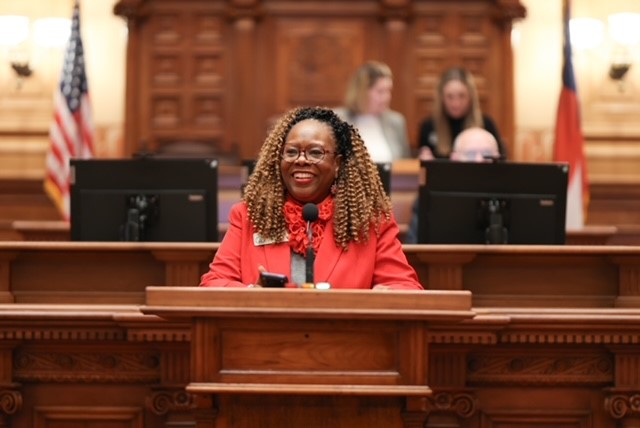
Representative Kim Schofield represents the citizens of District 63, which includes a portion of Fulton County. She was first elected to the House of Representatives in 2017 and currently serves as Secretary of the Urban Affairs Committee. She also serves on the Creative Arts & Entertainment, Health, Industry and Labor and Small Business Development committees.
###